You can feel completely well during pregnancy and still have high blood sugar. That is what makes gestational diabetes easy to miss. Most women have no symptoms, and it is usually found only because a blood test was done. This World Diabetes Day, 14 November, here is what the test involves, why it matters for you and your baby, and what happens if your result comes back high.
Quick Guide: Gestational Diabetes in Pregnancy
- Gestational diabetes is high blood sugar that first appears during pregnancy. It happens when your body cannot make enough insulin to meet the extra demands of pregnancy.
- It usually causes no symptoms. Screening is the only reliable way to find it.
- In India, every pregnant woman should be tested. National guidelines from the Ministry of Health (2018) recommend a test at the first antenatal visit, and again at 24–28 weeks if the first is normal.
- The test is simple. You drink a 75 g glucose solution and have your blood sugar checked two hours later. You do not need to come fasting.
- Most women manage it with diet and activity. Some need medicine. Most still have healthy pregnancies and healthy babies.
- It usually goes away after birth, but the risk stays. Women who have had it are more likely to develop type 2 diabetes later, so follow-up testing matters.
What Is Gestational Diabetes?
During pregnancy, the placenta makes hormones that make your body less responsive to insulin. Insulin is the hormone that moves sugar from your blood into your cells. Most women’s bodies simply make more insulin to compensate.
When the body cannot keep up, blood sugar rises. That is gestational diabetes. It is not something you caused by eating sweets, and it does not mean you had diabetes before you were pregnant. Sometimes, though, testing during pregnancy uncovers diabetes that was already there.
The NHS describes gestational diabetes as high blood sugar that develops during pregnancy and usually disappears after giving birth.
Why Does It Matter for You and Your Baby?
When a mother’s blood sugar stays high, extra sugar crosses the placenta. The baby’s body responds by making more insulin and storing the extra energy, which can make the baby grow larger than expected.
According to the NHS, gestational diabetes can lead to the following.
For the baby
- Growing larger than usual, which can make delivery harder and raise the chance of induced labour or a caesarean section
- Too much amniotic fluid around the baby
- Being born early (premature birth)
- Low blood sugar or jaundice after birth
- Stillbirth (this is rare)
For the mother
- Pre-eclampsia, a condition that causes high blood pressure in pregnancy
- A higher risk of type 2 diabetes in the future
That list can sound alarming, but the NHS also notes that most women with gestational diabetes have otherwise normal pregnancies and healthy babies. Finding it early and keeping sugar levels in range is what makes the difference.
Gestational Diabetes Risk Factors: Who Is More Likely to Get It?
Any pregnant woman can develop gestational diabetes. The NHS lists these factors as raising the risk:
- Being over 40
- A body mass index (BMI) above 30
- A previous baby who weighed 4.5 kg or more at birth
- Gestational diabetes in an earlier pregnancy
- A parent, brother or sister with diabetes
- South Asian, Black, African-Caribbean or Middle Eastern family origin
- Previous weight-loss surgery
South Asian origin is itself a listed risk factor, which is one reason India’s guidelines recommend testing every pregnant woman, not just those who seem “high risk”.
It is also common in India. A community study from Tamil Nadu, published in 2008, found gestational diabetes in 17.8% of pregnant women in urban areas, 13.8% in semi-urban areas and 9.9% in rural areas. Figures differ between regions, and there is no published figure specific to Dehradun or Uttarakhand.
What Are the Symptoms of Gestational Diabetes?
Usually, there are none, which is why screening matters.
Some women notice signs of high blood sugar, such as feeling very thirsty, passing urine more often, a dry mouth, tiredness, blurred vision or repeated vaginal thrush. But as the NHS points out, many of these are common in pregnancy anyway, so you cannot rule gestational diabetes in or out by how you feel.
That is why testing is part of routine antenatal care, not something done only when a woman feels unwell.
How Is Gestational Diabetes Tested in India?
The Ministry of Health and Family Welfare published national guidelines in February 2018. As summarised in the Journal of Family Medicine and Primary Care (2018), they recommend:
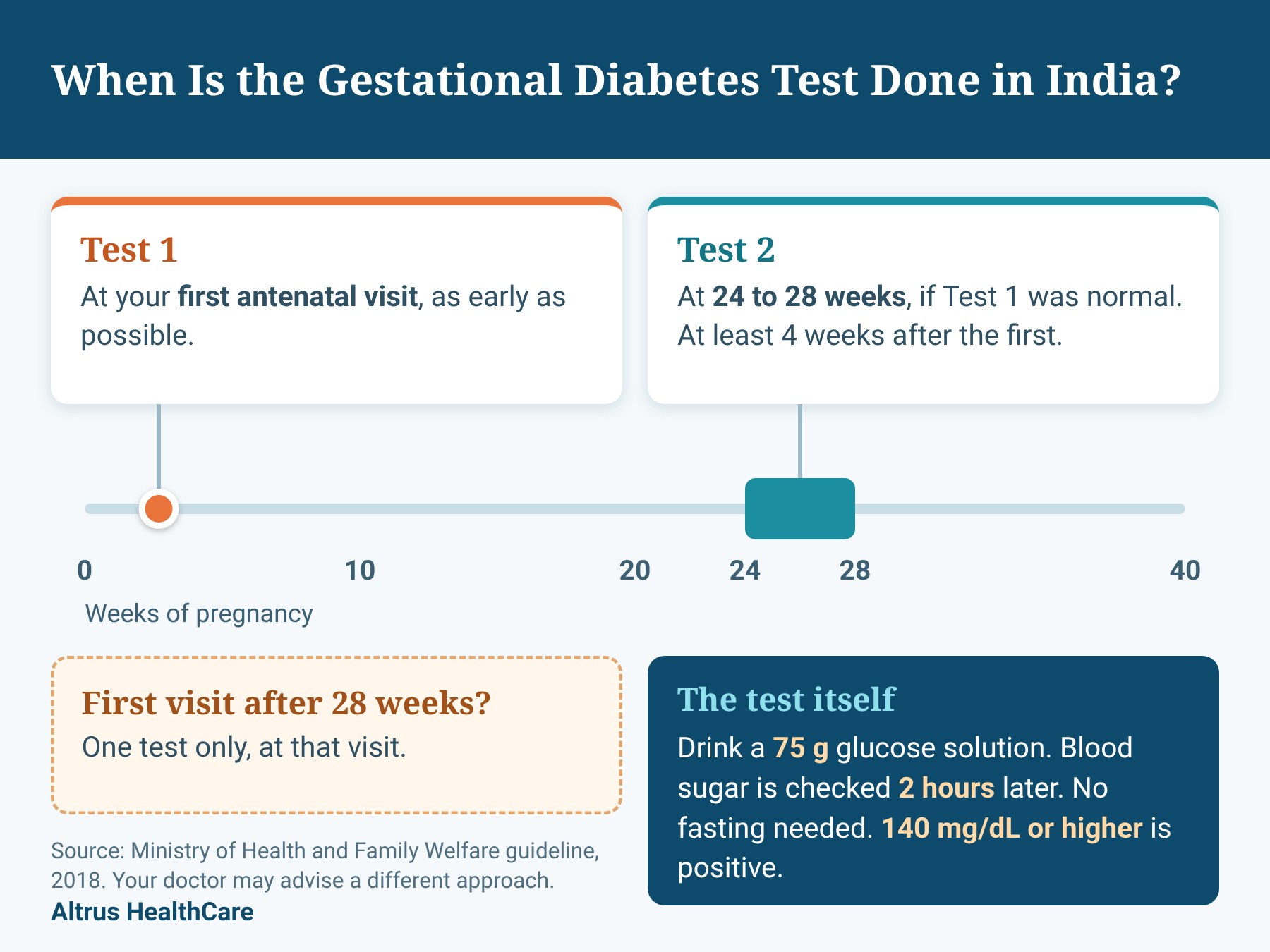
- First test at your first antenatal visit. Every pregnant woman should be tested, as early as possible.
- A repeat test at 24–28 weeks if the first result was normal, with at least four weeks between the two tests.
- One test only for women who first come for antenatal care after 28 weeks.
The test itself: You drink a solution containing 75 g of glucose. Two hours later, your blood sugar is measured. Under the national guideline, you do not need to come fasting, and the test is done regardless of when you last ate.
The result: A two-hour value of 140 mg/dL or higher is considered positive for gestational diabetes.
Your doctor may use a different testing approach depending on your history, and different countries use slightly different methods and cut-offs. If you are unsure which test you are having and why, ask.
What Happens If Your Test Result Is High?
A high result is not an emergency. It means your doctor can start a plan for you. Treatment is planned for each woman individually. Your doctor will take into account your test results, how far along you are, your general health and your baby’s growth. In general, care involves:
Diet and activity. For most women, the first step is a structured eating plan alongside regular physical activity suitable for pregnancy. For many women, this alone brings sugar levels into range.
Regular blood sugar checks. Your doctor will tell you when to check your sugar and what your own targets are.
Medicine if needed. If diet and activity are not enough, your doctor may add medicine, such as tablets or insulin. Which medicine, when it starts and the dose are decided for you specifically.
Needing insulin does not mean you have failed. Your body needs more help than diet can give during this pregnancy, and insulin is a well-established treatment in pregnancy.
What does eating well look like?
Your doctor or dietitian will give you a plan suited to you. Common principles include:
- Eating smaller meals at regular times, rather than skipping meals and then eating a large one
- Choosing whole grains, dals and vegetables over refined flour, white rice in large amounts, and sweets
- Avoiding sugary drinks, including packaged fruit juices
- Pairing carbohydrates with protein, which helps slow the rise in blood sugar
For more on eating well with diabetes or high blood pressure in pregnancy, read our guide on dietary advice for women with diabetes and high blood pressure.
Does Gestational Diabetes Go Away After Birth?
In most women, yes. Blood sugar returns to normal after delivery.
Even so, having had gestational diabetes raises your risk later. The NHS notes that women who have had it are more likely to develop it again in a future pregnancy, and more likely to develop type 2 diabetes later in life.
That makes follow-up important. In the UK, the NHS recommends a diabetes blood test 6 to 13 weeks after birth, and then once a year if that result is normal. Your doctor will advise the follow-up schedule that suits you. Whatever the schedule, do not skip it, and if you notice signs of high blood sugar in the meantime, get checked without waiting for your next test. A regular annual health check-up is a good way to keep that habit.
This is why World Diabetes Day matters for new mothers too. A pregnancy with gestational diabetes is an early warning, and acting on it can protect your long-term health.
What Questions Should You Ask Your Doctor?
If you have been diagnosed with gestational diabetes, these questions can help you understand your plan:
- What were my test results, and what do they mean?
- Do I need to check my blood sugar at home? If so, when, and what are my targets?
- Can I see a dietitian, or get a written eating plan?
- What kind of exercise is safe for me, and how much?
- If I need medicine, which one, and why?
- Will I need extra scans to check my baby’s growth?
- Does this change where or how I should deliver?
- When should I be tested again after my baby is born?
Write the answers down, or ask a family member to come with you.
How Can Your Family Help?
Gestational diabetes is easier to manage when the family supports you.
- Eat the same meals. Healthy, balanced meals with fewer sweets and refined carbohydrates are good for everyone, and make it easier for you to stick to your plan.
- Walk together after meals. A short walk after eating is a simple habit the family can share.
- Avoid pressure to eat sweets at festivals and family functions. A polite “doctor’s advice” is enough.
- Come to appointments, so someone else hears the advice too.
Pregnancy and Antenatal Care at Altrus HealthCare, Dehradun
- Obstetrics and gynaecology team who provide routine antenatal care, including screening for gestational diabetes at the recommended stages of pregnancy.
- On-site diagnostics, so blood tests and scans can be done during your visit.
- NICU on site, so if your baby needs extra care after birth (for low blood sugar, jaundice or early arrival), specialist newborn care is in the same building.
- Paediatrics and neonatology, for your baby’s check-ups after you go home.
- 24×7 emergency care, for any concern in pregnancy that cannot wait.
To book an antenatal consultation at Altrus HealthCare, call 0135-3101600. For 24×7 emergencies, call +91 92582 35140.
You may also find these helpful: pregnancy care tips for a healthy mother and baby and why every pregnant woman needs a trusted gynaecologist.

Written by
Dr. Anoosha K Ravi
Gynaecologist, Altrus HealthCare, Dehradun