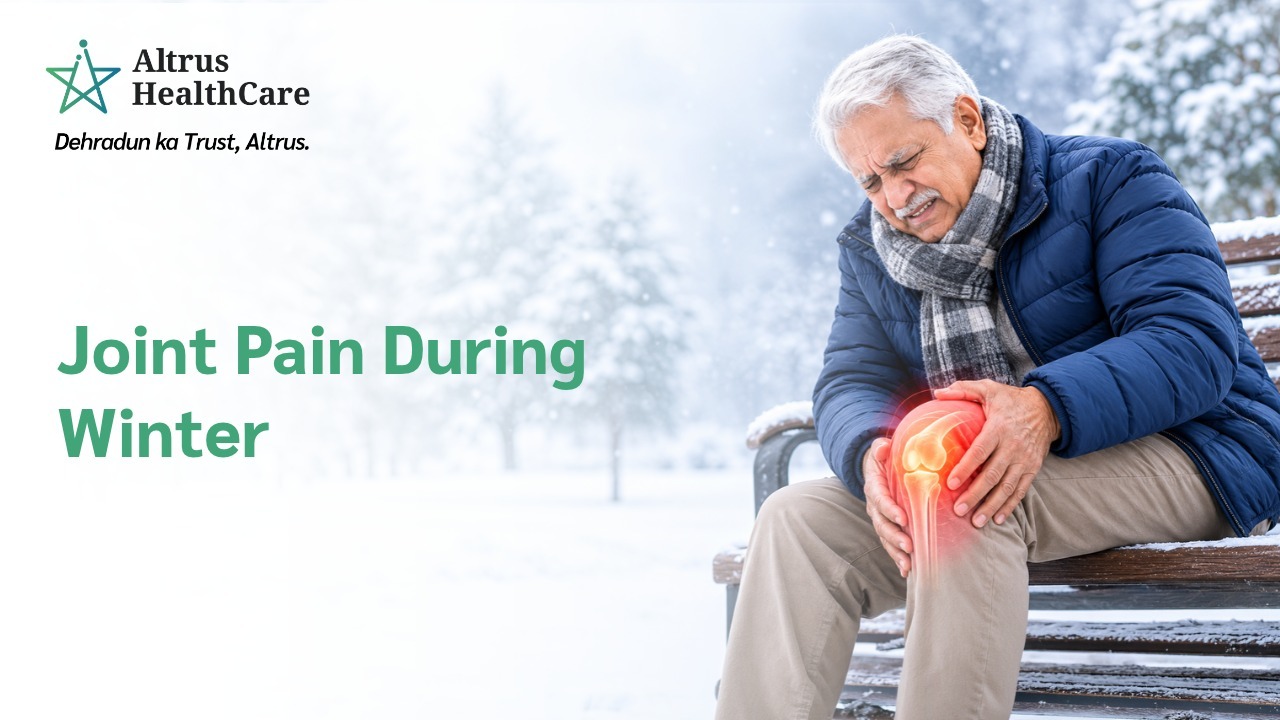
If your knees ache more on a damp December morning, you are not alone — and you are not imagining it. Many people with arthritis say their joints feel worse in winter. The science behind that is more surprising than most people expect, and understanding it can help you focus on the things that may ease the pain.
Quick Guide: Arthritis and Winter
- Weather does seem to affect joint pain — but only modestly. A large UK study of 2,658 people found pain was linked to higher humidity, lower air pressure and stronger wind.
- Cold temperature on its own was not linked to more pain in that study. Damp, windy, low-pressure days were.
- Winter habits may matter as much as the weather. People tend to move less in the cold, and inactive joints stiffen.
- Staying active is a core treatment for osteoarthritis, along with keeping a healthy weight, according to the NHS.
- Warmth helps comfort. Warm clothing, a warm bath and gentle stretching can ease morning stiffness.
- See a doctor for a joint that is hot, red and swollen, pain that stops you walking, or pain that keeps getting worse.
Does Cold Weather Really Make Arthritis Worse?
This is one of the oldest beliefs in medicine — that people with arthritis can “feel the weather in their bones.” For a long time, research gave mixed answers.
One of the largest studies so far was the Cloudy with a Chance of Pain project, published in npj Digital Medicine in 2019. Researchers in the UK asked people with long-term pain, including arthritis, to record their pain every day on a smartphone app. The phone’s location was then matched to local weather data. Data from 2,658 people who recorded their symptoms regularly were analysed.
What they found:
- Higher humidity was most strongly linked to more pain.
- Lower air pressure and higher wind speed were also linked to more pain.
- Temperature was not significantly linked to pain.
- Rainfall was not linked either.
The authors described these effects as real but modest. On the most painful combination of weather, the chance of a painful day was about 20% higher than on an average day.
So the honest answer is: weather does seem to play a part, but a small one. And for most people, a “cold day” is also a damp, grey, still day spent mostly indoors — which brings us to the part you can change.
Why Might Joints Feel Worse in Winter?
Even if cold temperatures are not directly to blame, winter changes daily life in ways that can make joint pain worse:
- Moving less. Shorter days and cold mornings mean fewer walks and more sitting. Joints that are not moved regularly tend to stiffen.
- Weaker muscles. When activity drops for weeks, the muscles that support the knees and hips lose strength, putting more load on the joint itself.
- Weight gain. Festivals, wedding season and less activity can add a few kilos — and extra weight increases pressure on knees and hips.
- Mood. Grey days and less time outdoors can lower mood, and pain often feels worse when we feel low.
The good news is that every one of these is something you can work on.
What Is Osteoarthritis?
Most joint pain in older adults is caused by osteoarthritis. The NHS describes it as the most common type of arthritis. The smooth cartilage that cushions the ends of the bones gradually wears down, causing pain, swelling and stiffness.
Joints most often affected: knees, hips and the small joints of the hands — though almost any joint can be involved.
Common symptoms:
- Joint pain and stiffness
- Difficulty moving the joint
- Swelling or tenderness
- A grating or crackling sound when the joint moves
Risk factors, according to the NHS:
- Older age
- Previous joint injury or overuse
- Being overweight
- Family history
- Being a woman
- Other joint conditions such as rheumatoid arthritis or gout
The NHS notes that osteoarthritis does not necessarily get worse over time, and can sometimes improve. Symptoms often come and go.
What Actually Helps Arthritis Pain in Winter?
1. Keep moving, every day
The NHS recommends exercise as a core treatment for osteoarthritis. Movement keeps joints flexible and strengthens the muscles that protect them.
Good winter options:
- A walk in the middle of the day, when it is warmest and brightest
- Indoor exercise — marching on the spot, stair steps, or chair exercises
- Gentle yoga or stretching each morning
- Cycling on a stationary bike
The NHS’s general activity advice for adults is 150 minutes of moderate activity a week, plus strength exercises on at least two days. If that sounds like a lot, start with 10 minutes and build up.
2. Strengthen the muscles around your joints
Strong thigh muscles take pressure off the knees. Simple exercises like straight-leg raises, sit-to-stand from a chair, and wall squats can help over a few weeks. A physiotherapist can give you a plan suited to your joints.
3. Manage your weight
Losing weight if you are overweight is one of the NHS’s main recommendations for osteoarthritis. Even a modest loss reduces the load on your knees and hips with every step.
4. Use warmth for comfort
Although cold temperature itself was not linked to pain in the 2019 study, many people find warmth soothing for stiff joints:
- Dress in layers, and keep knees and hands warm on cold mornings
- A warm bath or shower before exercise can ease stiffness
- A warm (not hot) compress on a stiff joint for 15–20 minutes
5. Wear supportive footwear
The NHS lists suitable footwear among the ways to manage mild osteoarthritis. Choose shoes with cushioned soles and good support, and avoid high heels and slippery soles — especially on wet winter roads.
6. Be careful with painkillers
Do not take painkillers regularly without talking to your doctor, and follow the dose they advise. Some common painkillers can affect the stomach, kidneys or blood pressure, especially in older adults or people on other medicines.
When Should You See an Orthopaedic Doctor?
Book an appointment if:
- Joint pain is stopping you from walking, climbing stairs or sleeping
- Pain or stiffness keeps getting worse over weeks
- Home measures and exercise are not helping
- Your joint gives way or locks
Seek urgent care if a joint becomes suddenly hot, red and very swollen — especially with fever. This can mean an infection in the joint, which needs treatment quickly.
For severe osteoarthritis that does not respond to other treatments, the NHS notes that surgery to repair or replace a joint is sometimes recommended. Read our guide on questions to ask before orthopaedic surgery if you are considering it, or how to choose the right orthopaedic surgeon for your condition.
Is It Osteoarthritis or Another Type of Arthritis?
Not all joint pain is osteoarthritis. The NHS notes that other conditions, such as rheumatoid arthritis and gout, can also affect the joints — and they need different treatment.
Some differences that help your doctor tell them apart:
| Osteoarthritis | Inflammatory arthritis (e.g. rheumatoid) | |
|---|---|---|
| Typical age | Usually older adults | Can start at any adult age |
| Morning stiffness | Usually short — under 30 minutes | Often long-lasting |
| Pain pattern | Worse with use, better with rest | Can be painful even at rest |
| Joints | Knees, hips, hands | Often the small joints of both hands and feet |
| Swelling | Sometimes | Often warm, puffy joints |
General guide only — a doctor’s examination is needed for diagnosis.
The NHS notes that osteoarthritis is suspected in people aged 45 or over whose pain gets worse with use and whose morning stiffness is absent or lasts under 30 minutes. If your joints are stiff for much longer in the morning, or several joints are swollen at once, see a doctor — this pattern needs proper assessment.
A Simple 10-Minute Winter Morning Routine
Stiff joints often feel worst first thing on a cold morning. This gentle routine can help you get moving. Stop any movement that causes sharp pain, and check with your doctor or physiotherapist before starting if you have had joint surgery.
- Warm up first (2 minutes). Have a warm drink, and if possible take a warm shower. Then march gently on the spot, swinging your arms.
- Ankle circles (1 minute). Sitting on a chair, lift one foot and circle the ankle slowly, ten times each way. Swap feet.
- Knee straightening (2 minutes). Sitting tall, straighten one knee until the leg is level, hold for five seconds, and lower slowly. Ten times each leg.
- Sit-to-stand (2 minutes). From a firm chair, stand up and sit down slowly, using your hands only if you need to. Start with five, and build up.
- Hand stretches (1 minute). Make a gentle fist, then spread your fingers wide. Ten times. Good for stiff hands on cold mornings.
- Calf stretch (2 minutes). Stand facing a wall, one foot behind the other, and lean forward gently until you feel a stretch in the back calf. Hold for 20 seconds each side.
Doing this every morning, and adding a short walk later in the day, is a practical start towards the NHS’s activity advice.
What Should You Ask Your Orthopaedic Doctor?
Take these questions to your appointment:
- What type of arthritis do I have, and how sure are we?
- Which exercises are safe for my joints, and which should I avoid?
- Would physiotherapy help me?
- Is my weight affecting my joints, and what is a realistic goal?
- Which painkillers are safe for me, given my other medicines and health conditions?
- What signs mean I should come back sooner?
Care at Altrus HealthCare
Altrus HealthCare in Dehradun has an orthopaedics team that includes joint reconstruction surgeons, paediatric orthopaedics, on-site diagnostics including X-rays and blood tests, and a 24×7 emergency department.
To book a consultation, call 0135-3101600. For 24×7 emergencies, call +91 92582 35140.
Frequently Asked Questions
1. Why do my knees hurt more when it rains? Research suggests damp air and low air pressure are linked to slightly more joint pain, though the effect is modest. A large UK study did not find a link with rainfall itself — but rainy days are often humid, low-pressure days.
2. Should I rest my joints when they hurt? Short rest during a flare is fine, but long periods of rest usually make stiffness worse. Gentle, regular movement is one of the main treatments the NHS recommends for osteoarthritis.
3. Is walking good for knee arthritis? For most people, yes. Walking keeps the joint moving and strengthens the muscles around it. Start with short walks on flat ground and build up gradually.
4. Will I need a knee replacement? Most people with osteoarthritis do not. Exercise, weight management and other treatments help many people manage. Surgery is considered when pain is severe and other treatments have not helped.
5. Can young people get arthritis? Yes. Osteoarthritis is more common with age, but injury can cause it earlier. Some types of arthritis also affect children and young adults, and need a doctor’s assessment.
Sources
- Dixon WG et al., How the weather affects the pain of citizen scientists using a smartphone app, npj Digital Medicine 2019;2:105. https://pmc.ncbi.nlm.nih.gov/articles/PMC6811599
- NHS, Osteoarthritis. https://www.nhs.uk/conditions/osteoarthritis/
Disclaimer
This article is for general information only. It is not medical advice, and it is not a substitute for examination, diagnosis or treatment by a qualified doctor. Joint pain has many causes. Speak to a doctor before starting a new exercise programme or medicine, and seek urgent care for a hot, red, swollen joint. In an emergency, call Altrus HealthCare on +91 92582 35140.