
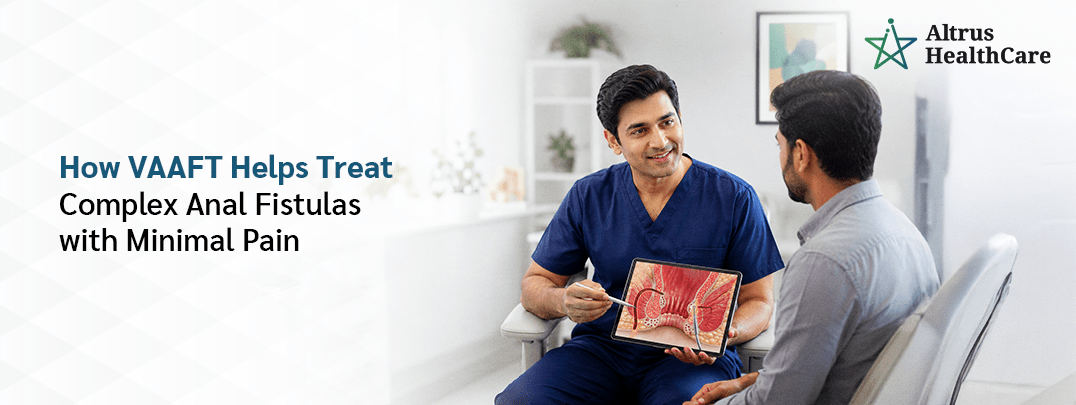
VAAFT is a relatively recent innovation in surgical treatment of complex fistulas, a minimally invasive technique that aims to spare the important bowel control mechanisms called sphincter muscles. Thorough patient selection ensures that the patient will find VAAFT to be a more comfortable alternative to traditional, more invasive operations.
Fortunately, surgeries for fistula have made much improvement in the last decade. Most promising is the VAAFT surgery– a minimally invasive surgery that enables the surgeons to address complicated fistulas while not damaging the important muscles of bowel control. For carefully selected patients, VAAFT treatment offers an effective alternative to more invasive operations with a shorter and more comfortable recovery.
Why Some Anal Fistulas Are More Difficult to Treat
An anal fistula is an abnormal track or passageway that runs from the lining of the anal canal to the skin outside the anus. A fissure typically forms after an infection called an anal abscess, a collection of infected material near or in the anus that doesn’t fully resolve. When the condition leads to more involved fistulas, they pose significant challenges for surgeons who must treat and close fistula tracts without causing the patient to experience loss of bowel control.
Early identification of the signs and anal fistula symptoms include a feeling of swelling and pain around the anus, repeated abscess formation or anal bleeding-will enable individuals to obtain timely and appropriate treatment before the disease becomes intractable.
What Makes VAAFT Surgery Different?
Instead of cutting down through the skin of the perineum to expose the fistula, VAAFT uses a scope (a tiny tube) to look into the fistula from the inside out.
A specially designed fistuloscope with a tiny camera is introduced through the external opening. When using the scope, the surgeon can directly visualise the entire fistula and its branches, using a special tool inserted into the scope to cauterize or tie off the fistula tract. The less tissue the surgeon disturbs the easier the wound is expected to be for the patient.
Because the surgeon works under direct visual guidance, VAAFT treatment is particularly useful for complex or recurrent fistulas where identifying every branch is essential.
Why Patients Often Recover More Comfortably
Postoperative pain is a common concern before any surgery.
However, because VAAFT surgery does not require external cutting or the creation of a large surgical wound, many patients experience considerably less pain compared to open surgery. The absence of a large surgical incision also means there is generally less wound care during recovery.
Many patients are able to return to light daily activities much sooner, although the exact recovery period depends on the complexity of the fistula and the individual’s overall health.
Is Every Patient Suitable for VAAFT Surgery?
Although VAAFT treatment has many advantages, it is not the right procedure for every anal fistula.
Low, simple fistulas can often be treated successfully with more straightforward surgical techniques.VAAFT is considered in patients with complex fistulas or recurrent disease, especially when the sphincter mechanism needs to be carefully protected.
As Dr. Mohammad Atif Khan, Consultant, Gastro-intestinal & General Surgery at Altrus HealthCare, explains, “The success of fistula surgery depends as much on selecting the appropriate procedure as performing it well. VAAFT allows us to visualise the fistula tract directly, which is especially valuable in carefully selected complex cases where preserving normal bowel function is a priority.”
Therefore, the decision on which approach to take requires accurate diagnosis and careful examination.
Looking Beyond the VAAFT surgery
Successful treatment involves more than surgery: Postoperative care to ensure proper healing, prevent complications, educate patients about home wound care, bowel management and diet, and guide them with the follow-up plan and visits is critical.
Most patients are advised to practice good hygiene in the anal area, maintain a high fiber diet to prevent constipation, and drink adequate liquids, and notify their physician of any concerns.
Specialised Care Makes a Difference
At Altrus HealthCare, Dehradun’s trusted multispeciality hospital, we understand that managing a complex anal fistula can be daunting. The surgical expertise in our GI & General Surgery team and VAAFT surgery approach are at the forefront of modern minimally invasive procedures in addressing complex anal fistulae and the most critical challenge, protecting maximal sphincter control to maintain bowel control. Each of our patients is cared for comprehensively, from the first assessment and consultations, through the procedure, surgery and follow up with an aim to help them return to their day-to-day life.
The Right Treatment Starts with the Right Assessment
Many patients, burdened with the presence of a persistent fistula, put off medical intervention, hoping it will spontaneously resolve, but it seldom does.
A continuously discharging fistula is a signal for professional medical intervention. Contemporary methods such as VAAFT surgery are revolutionising the management of challenging or complex anal fistulas and their recurrent form. The minimally invasive nature of these techniques permits a less invasive approach to these challenging issues, resulting in a less uncomfortable and speedier recovery. Treatment must be individualised to the unique architecture of each fistula; no “one size fits all” solution.